
Learn More About...


Who are Fawns?
We're the longest-established school playground equipment provider around - we know a thing or two about playground design.
With family-ran roots, schools, MATs, nurseries and parish councils trust us to create outdoor playgrounds with a purpose.
Playground Ideas for Primary Schools: Design Ideas That Solve Real School Challenges
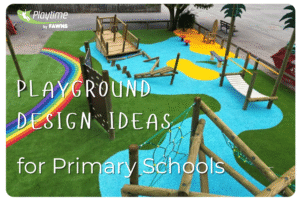
A well-designed playground does far more than keep children busy between lessons. It’s a space where confidence grows, friendships form, and skills for life take root.
At Fawns, we’ve spent more than 30 years helping schools transform outdoor spaces into inspiring play environments. This article brings together our best playground ideas for primary schools, from creative designs for small spaces to clever ways to support regulation, social skills, and learning.
Before diving into the ideas, it’s worth pausing on something important: the why.
What problem is your playground helping to solve?
As with any strategic decision, intent is everything. The most effective playgrounds are designed to tackle real challenges.
Your playground might help address a common national issue:
- High levels of speech language and communication needs (SLCN) on entry
- Rising numbers and complexity of SEND needs
- Increasing SEMH (social, emotional and mental health) needs
- Childhood obesity and inactivity
- Low attendance or engagement
- Friendship challenges or social conflict
- Falling pupil wellbeing and mental health rates
- Fundamental Movement Skills (FMS) as a development priority
Or it might respond to a school-specific challenge:
- Low activity levels among pupil premium groups
- KS1 and KS2 sharing space without clear zoning
- Rising injuries or unsafe play due to unmet need
- Limited supervision and high numbers of disengaged pupils
- Increasing behavioural challenges during playtimes
Once you know the challenge your playground needs to help solve, the rest, from layout to equipment choice, becomes clear.
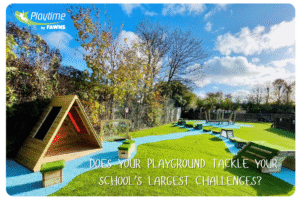
Why your playground is your most valuable asset
On average, only 45% of children achieve the minimum recommended 30 minutes of daily activity during school hours. This contributes to just 48% meeting the national goal of 60 minutes of movement per day. Even with that low target, most children fall short, despite spending over a third of their waking hours at school.
Your playground is the single biggest opportunity to close that gap. Beyond play, it’s a place to reset, regulate, and refocus between lessons, giving pupils the downtime and stimulation they need for purposeful learning.
A well-designed playground delivers more than movement. It strengthens every aspect of development:
- Physical– stamina, strength, balance, and coordination
- Cognitive– improved memory, focus, and problem-solving
- Emotional– regulation, confidence, and resilience
- Social– teamwork, empathy, and communication
- Creative– imagination, exploration, and curiosity
A well-designed school playground supports both wellbeing and learning not as an add-on, but as an educational tool.
Where to begin when looking for school playground ideas? We share our favourites for the types of spaces you have available and the challenge your playground is helping to solve.
If you’d like playground ideas based on your budget (either from fundraising, funding or grants or capital expenditure), our Fawns Projects page is packed full of playground design ideas for every budget: under £10k all the way to transformations of £100k and over.
Playground ideas for primary schools
Once you’ve defined your school playground goal, you can start shaping your play space design around it.
Here are some of the most effective design ideas from Fawns projects across the UK.
Jump ahead to:
- Ideas to make the most of playground space
- Ideas to support all pupils’ needs
- Ideas to help children regulate and refocus
- Ideas to boost fundamental movement skills
- Ideas for quick but lasting improvements
- Ideas for PE and playtime combined
- Ideas for concrete-only spaces
- Ideas for shared or multi-age spaces
- Why schools choose Fawns
Playground ideas to make the most of spaces
Across England, schools are finding new ways to get more value from every square metre. With activity levels consistently falling short of national movement recommendations, outdoor space design has never mattered more.
Many schools face layouts that aren’t the classic open playground and field space. Working with sloped ground, split sites, or limited access can all make varied daily movement harder to achieve for school leaders.
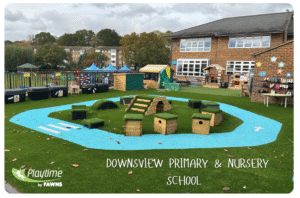
If your site has awkward corners, unloved edges or a slope, design can turn them into high-value zones. Try:
Compact trim trails that run along fences or paths. Each component is selected to match your pupils, so you can build a custom sequence or cherry-pick components. This is perfect for creating a simple sensory circuit that targets vestibular, proprioceptive and tactile input without overwhelming the space.
- Playground markings to define zones and guide movement with tracks, trails and game grids that prompt active play all day.
- Raised planters and school benches so rest areas also work as social and learning spots.
- Free flow shelters or all-weather canopies to unlock the space year-round.
Downsview Primary and Nursery’s (£41K project) EYFS area shows how clever surfacing and layout can open up circulation and choice, giving little learners clear places to move, rest and explore.
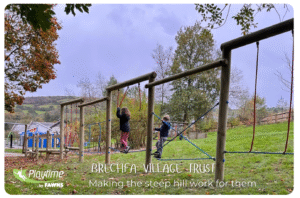
Over in Wales, Brechfa Village Trust (£17K project) used a slope to anchor a trim trail that invites climbing, balancing and route finding, proving gradients can become the most exciting part of the playground.
Playground ideas to support all pupils’ needs
Schools are seeing higher and more complex SEND needs than ever before. In 2025, SLCN were the most common primary need among pupils receiving SEN support, closely followed by SEMH needs. The overall number of pupils requiring additional support in mainstream settings continues to rise each year.
Designing inclusively means anticipating barriers and removing them from the start, so every child can achieve, belong and thrive together. Consider:
- Wheelchair-accessible, low-height play equipment such as Sensory Island-style units that allow parallel and shared play
- Musical instruments and activity panels that offer rich tactile and auditory input for joint attention, language and turn-taking
- Quiet nooks and shaded micro-zones for calm re-engagement and relationship building
- Physical development equipment that supports regulation through heavy work so pupils can spend energy safely and return ready to learn
Some children seek vestibular input and will climb anything to get it. Others are risk-averse and need gradual challenge. A mixed set of safely designed elements gives both groups what they need without resorting to unsafe improvisation.
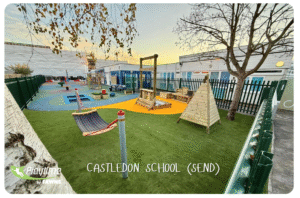
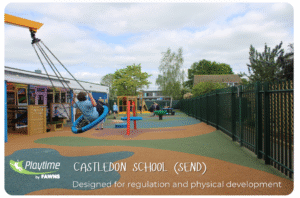
Castledon School (£125K project) is a strong example. The inclusive layout was planned to remove play barriers for their pupils while building capacity for regulation and physical intervention. The result blends sensory paths, balance elements and social play stations so every child can participate and progress.
Playground ideas to help children regulate and refocus
Supporting SEMH needs has become a mainstream priority. In 2023, around one in five children aged 8 to 16 were identified as having a probable mental health disorder.
With school budgets stretched and support staff capacity limited, thoughtful playground design can make daily emotional regulation more achievable for every pupil.
Design for regulation by combining:
- Heavy work opportunities that feed the proprioceptive system, such as rope bridges, climbing nets, monkey bars and climbing A-Frames that ask for gripping, bracing and weight-bearing
- Sensory paths that provide predictable rhythm and texture so pupils can downshift or re-engage
- Activity panels for focused, hands-busy tasks that support co-regulation with peers and adults
- Small group seating that make restorative and relationship-building conversations easy
For children to regulate their sensory, emotional or nervous systems, they often need a reset that moves children from reactive to reflective. Movement is a practical bridge. As pupils shift into a physical activity, they gain the grounding that makes problem solving and reflection possible, all whilst improving their mental health.
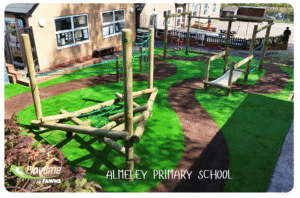
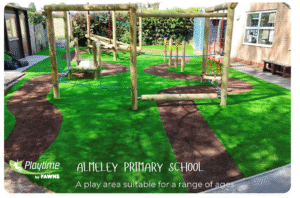
Almeley Primary (£30K project) shows how this looks in practice. Their active trim trail gives children positive outlets throughout the day, which supports their children with regulation and helps them come back to the classroom calmer, more connected and ready to learn.
Playground ideas to boost fundamental movement skills
Ofsted’s research review on PE found that too few pupils are mastering the balance, coordination and agility needed to progress in sport. Ofsted explains that fundamental movement skills (FMS) are the key to every physical activity, from climbing to basketball.
Without strong FMS, pupils struggle with control, timing and spatial awareness. The basics needed before tactics or teamwork can even begin.
Playgrounds give children daily, low-pressure opportunities to refine these skills through active exploration. Consider:
- Trim trails with popular log traverses and stepping stones to build stability and rhythm
- Climbing walls and embankment scramble nets to develop upper-body strength and coordination
- Target panels and basketball hoops to improve control, reaction and accuracy
- Health trek trails to encourage fluid, confident movement
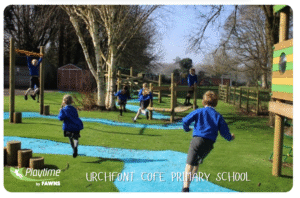
At Urchfont CofE Primary (£70K project), a full playground transformation introduced a large active play zone where children can climb, balance and explore every day. The design encourages movement across the whole space, building pupils’ coordination, confidence and focus through natural, self-directed play.
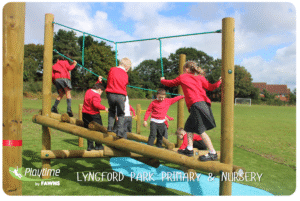
Lyngford Park Primary (£25K project) transformed an underused field into an active zone that encourages agility, balance and control. The new layout gives children a fun way to practise core skills that now transfer naturally into PE sessions and team games.
Playground ideas for quick but lasting improvements
Many schools think playground improvements mean large budgets or long build times, but thoughtful planning can deliver lasting impact in just a few days.
By using Sports Premium funding strategically, even smaller investments can transform underused areas into engaging, high-value play spaces.
Schools looking for quick, high-value results can consider:
- Essential trim trails that can be installed in as little as two working days
- Playground markings to revitalise old spaces and inspire activity
- Portable and freestanding physical development blocks to add flexible learning and movement options
- Wooden seating or social areas that double as outdoor classrooms
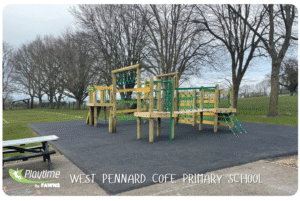
West Pennard C of E Primary’s trail (£18K project) was fitted during term time with minimal disruption, transforming their outdoor space into an activity hub for a range of ages.
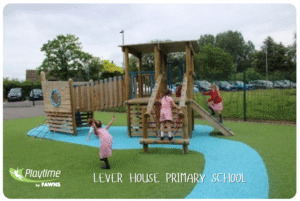
Lever House Primary School (£25K project) achieved similar results using new surfacing and climbing features to boost both physical activity and engagement across breaktimes.
Playground ideas for PE and playtime combined
More schools are designing playgrounds that work just as well for PE lessons as they do for free play. When equipment supports both structured activity and spontaneous movement, pupils stay active more often and in more varied ways throughout the school day.
Create spaces that extend PE into play by including:
- Multi-use games areas (MUGAs) for football, basketball, and small-team activities
- Activity goals and target walls to build accuracy, coordination, and friendly competition
- Outdoor gym equipment that supports strength, stamina, and circuit-style training for older pupils
- Health Trek trails to encourage whole-school participation in daily movement challenges
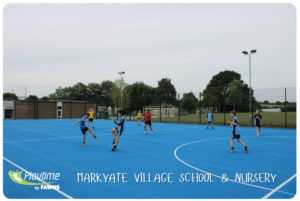
At Markyate Village School and Nursery (£180K project), a fully enclosed Multi-Use Games Area (MUGA) transformed a previously water-logged, unusable field into a vibrant, year-round play and sport hub. Teachers now report a marked increase in daily movement, more pupils engaging in lunchtime and after-school sport clubs, and improved confidence and coordination across all year groups.
Playground ideas for concrete-only spaces
School communities change every year, but the outdoor space usually stays the same. For many schools, that means making the most of a concrete or fully hard-surfaced playground. With a little creativity, these spaces can still offer imaginative play that support the whole curriculum.
For concrete-only playgrounds, consider:
- Wetpour, Durabond or Duralawn playground surfacing to introduce colour, safety, and texture
- Playground markings to define movement zones, circuits, and cooperative games
- Themed play equipment and modular climbing units to add height and variety
- Planters or tabletop games to connect pupils with nature and each other
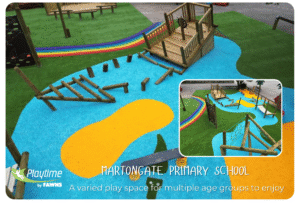
For Martongate Primary School (£28K project), a tired tarmac yard became a “Treasure Island” hub where children climb, balance, act and read. The mix of themed active play, a small stage, traverse and seating has turned a once flat space into a multi-use area that works for imagination and movement across age groups.
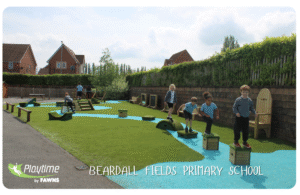
Flooding used to wipe out Beardall Fields EYFS play space (£50K project). So, we redesigned the area with drainage and all-weather surfacing, then layered in early years play that supports mark making, physical development and storytelling. The result is an EYFS space pupils can use all year, with clear routes for movement and calm corners for language and role play.
Playground ideas for shared or multi-age spaces
Many primary schools share their outdoor areas between year groups or even with after-school or holiday clubs. The challenge is to create a space that feels exciting for everyone, yet safe and age-appropriate for each stage of development.
Design flexible shared spaces by including:
- Graduated challenge routes so children of different ages can play side by side and build confidence at their own pace, our popular Space Frames offer a range of challenge and low free-fall heights
- Low free-fall height equipment that allows younger pupils to join in safely while still challenging older ones, our Pick Up Sticks range is a great example
- Moveable equipment like EYFS physical development blocks and mini trim trails allow for easy adaptation during clubs or mixed-age sessions
- Playground fencing and zoning to define areas for different age groups without limiting visibility or inclusivity
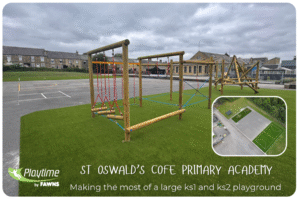
For St Oswald’s CofE Primary Academy (£44K project), the new playground brought Key Stage 1 and 2 pupils together in one inclusive space. What was once a limited area has become a lively, flexible playground where children of all ages can challenge themselves safely and build confidence at their own pace.
Why Fawns Is the Number 1 Choice for School Playgrounds
At Fawns, we believe playgrounds are where potential begins. Every design is built around learning, wellbeing, and inclusion, creating spaces that grow with your pupils.
Schools choose Fawns because:
- We bring over 30 years of design expertise to every project
- Our UK-manufactured equipment is built to last and designed for safety
- We understand how children play, learn, and regulate, so our playgrounds are grounded in child development, not just aesthetics
- We work collaboratively with schools to design spaces that meet real needs, from concept to installation
If you’re ready to make your playground work harder for your pupils, book a free playground design consultation with our team today.
Let’s turn your outdoor space into a place where learning, play, and imagination belong and thrive every single day.

More articles you’ll like:
Creating Amazing Playgrounds: A Guide for Schools
Who are Fawns?
We're the longest-established school playground equipment provider around - we know a thing or two about playground design.
With family-ran roots, schools, MATs, nurseries and parish councils trust us to create outdoor playgrounds with a purpose.


Other Blog Posts




We are the one-stop-solution for outdoor playground equipment for schools and parks across the UK.
Based in Hampshire, we pride ourselves on delivering high-quality, durable and innovative school playgrounds.
Fawns Recreational Services Limited - Company Registration Number: 03863973
Site Links
Contact
- 01252 515 199
- sales@fawns.co.uk
- Beech House, Ancells Business Park, Fleet, Hampshire, GU51 2UN

© Playtime By Fawns | 2026 website developed & maintained by digidoda
This site is protected by reCAPTCHA and the Google Privacy Policy and Terms of Service apply.