Learn More About...


Who are Fawns?
We're the longest-established school playground equipment provider around - we know a thing or two about playground design.
With family-ran roots, schools, MATs, nurseries and parish councils trust us to create outdoor playgrounds with a purpose.
How to choose a climbing frame for your school
Choosing a climbing frame for your school is one of those decisions that feels straightforward on the surface and quickly gets overwhelming.
There are lots of options, a range of price points and plenty of playground suppliers all telling you theirs is the best. So where do you start?
This guide is for the people doing the research, whether you’re a headteacher, a school business manager gathering quotes, a SENDCo thinking about inclusive provision, or a MAT lead reviewing multiple sites at once.
What to think about before you start
Before you choose the right climbing frame for your school, it’s worth getting clear on a few things:
- Who will use it? Reception children have very different needs from Year 6, and secondary pupils are different again.
- How much outdoor space do you have, and what shape is your playground?
- What do you want the climbing frame to do for your pupils, physically, socially and in terms of inclusion?
- What’s your budget? (including surfacing)
- How will staff supervise children using it?
Getting answers to these questions early will save you time and help your chosen playground supplier design you a climbing frame that fits your school.

Understanding height and free-fall
This is one of the areas that causes the most confusion when schools choose a climbing frame, so it’s worth spending a moment on it.
The measurement that matters for safety isn’t the overall height of the structure.
It’s the free-fall height, which is the distance a child could fall from the highest accessible part of the equipment (this is what’s governed by BS EN 1176, the British and European safety standard for playground equipment).
A taller-looking frame doesn’t automatically mean a harder or more age-appropriate challenge.
A climbing frame for all school ages
For KS2 children, challenge can come from climbing angles, rope elements, upper body demands and the distance of a traverse rather than how high they’re standing.
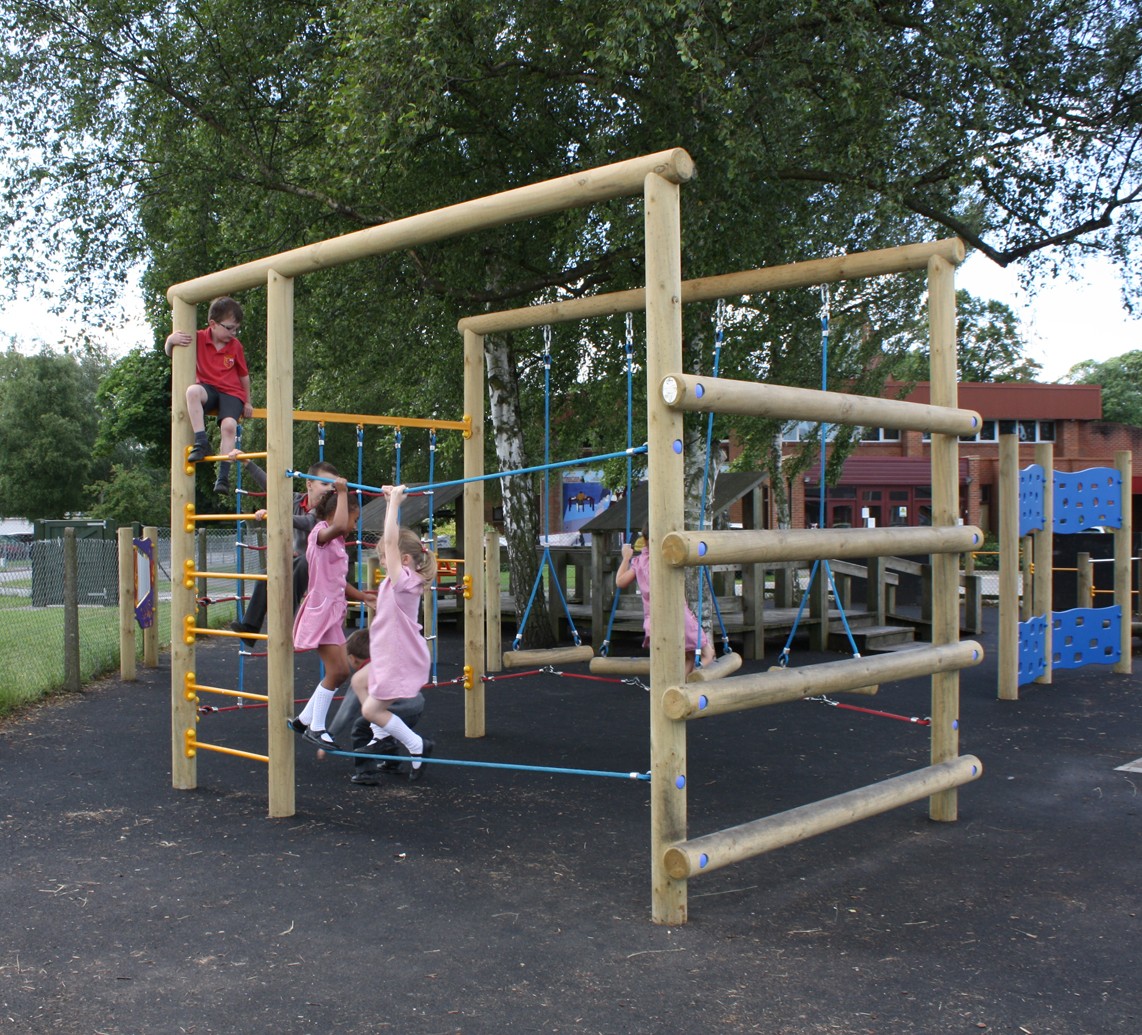
A well-designed primary school climbing frame can be suitable for both KS1 and KS2 pupils within the same structure, with different elements offering different levels of difficulty.
Climbing frames and playground flooring
Free-fall height also determines what surfacing you’ll need. Structures with a free-fall height below 0.6 metres can sometimes sit on well-maintained grass without additional surfacing.
Anything above that will typically require impact-absorbing surfacing like Wetpour or Durabond, and that’s a cost to factor your Fawns playground consultant will talk you through during step one of the process: your free playground visit.

A timber or metal climbing frame?
Many outdoor climbing frames for schools are made from timber, as the benefits of timber play equipment are easy to see.
Treated softwood looks at home in a school playground, it’s durable, sustainably sourced and weathers well in the UK climate. Wooden climbing frames also feel less industrial, which matters for making your outdoor playground or garden space feel more natural.
You’ll likely see a few more metal frames are in secondary schools and community park environments. Especially with the increase in popularity in outdoor calisthenic gyms in secondary schools.
Fawns’ outdoor fitness equipment range covers this style if it fits your school’s needs.
Neither material is automatically better. It comes down to your setting, your pupils and what you’re trying to achieve. School leaders have automatic confidence that any playground from Playtime by Fawns meets British and European safety standards as a minimum.
Climbing frames for secondary schools
Secondary schools are often left out of the conversation around climbing frames, and they shouldn’t be.
Older pupils benefit from outdoor play and physical challenge just as much as younger children, but the brief looks different.
For secondary-age students, the focus shifts towards bodyweight strength training (calisthenic workouts), balance, problem-solving and peer challenge.
Multi-use structures and fitness-style frames tend to work better here than traditional tower designs.
Many secondary schools use outdoor fitness equipment to increase pupils’ activity levels and to support teenagers to access healthier lifestyles without the need for expensive memberships and travel to and from private gyms.
Playtime by Fawns has a huge range of outdoor fitness equipment for secondary-aged pupils. From outdoor gym equipment, multi-gym units, outdoor calisthenics units and health trek trails to choose from designed with older users in mind.
The information page on how we work with secondary schools is a useful starting point if that’s your setting.

School climbing frame features that matter
Once you know your audience and your space, the next question is what you want on the climbing frame.
Here’s what’s worth thinking about beyond how it looks.
Slides, ramps and easy access points
Easy entry and exit points are about more than convenience. They affect how children move through the equipment, how confident pupils feel using it and how accessible the frame is for children with physical or mobility needs.
Ramps and wider platforms open the structure up to a much broader range of users. The 500 castle sensory island is a good example of how this can be built in from the start.
Physical challenge built-in
Monkey bars, climbing walls, rope nets and traverse features all develop the fundamental movement skills that sit at the heart of a good PE curriculum.
The goal is to give children a progression of challenge that builds confidence over time.
Sheltered and covered areas
In the UK, a climbing frame that includes a covered platform or shelter extends the time children spend outside when the weather turns, and in most parts of the country that’s often.
Covered areas also become social spaces and calmer corners. The New Forest Range and Themed Tower Range are two examples of many ranges that include shelter options.
Supervision sightlines
A school climbing frame that creates hidden spots can be a safeguarding concern.
Good design means clear supervision sightlines, lots of open platforms, flexibility to avoid solid panels and layouts that allow a member of staff to see across the structure from several sightlines.
SEND and inclusive play
For SENDCos and inclusion leads, looking for ways to improve SEND provision in mainstream settings, a balance of inclusion and accessibility needs to be achieved.
Finding climbing frames with wide ramps, low-demand entry and exits points, sensory panels, sensory circuit ideas built-in and quieter spaces within the structure all support children to play together.
Inclusive design isn’t a separate product category, it’s a design approach applied from the beginning. It’s something we pride ourselves on at Fawns, we’re known for our purposeful playground design, moving beyond a playground that’s designed with engagement in mind (but underpinned by evidence-based pedagogy and child development).
What does a school climbing frame cost?
Cost is driven by the size of the climbing frame, the size of the overall playground project, and the surfacing that comes with it. Playground surfacing is the part that most often catches schools by surprise, so ensure your playground supplier includes this within your itemised quote (ours is as standard).
If budget is a challenge, there’s lots of ways you can fundraise using your PTA for organisation support, we’ve a blog packed full of small and large fundraising ideas.

Working with the right playground supplier
Choosing a school climbing frame is only half the decision. Choosing who designs, manufactures and installs it matters just as much.
A good playground designer will visit your site to look at your space, ask about your pupils, talk through your school’s wants and needs and come back with a design that fits your current and future pupil needs.
You should expect full transparency about compliance with BS EN 1176 and clarity on what surfacing your chosen structure will require. A reputable playground manufacturer will make both of those things straightforward to understand.
At Fawns, we’ve been designing and installing climbing frames for schools across the UK for over 35 years.
As a playground supplier trusted by schools, MATs, and nurseries, we design every project around the setting and the children who’ll use it.
Our wooden climbing frames are made to order in our UK workshop, and every project starts with a free design consultation and 3D visualisation so you can see your dream play space brought to life.
Get in touch with our friendly team to start the conversation.

More articles you’ll like:
Top 10 pieces of inclusive playground equipment
How to use and get the most from sensory play equipment
How to create a sensory garden in your school
Frequently asked questions about climbing frames for schools
What is the safest height for a primary school climbing frame?
The measurement that matters is free-fall height rather than the overall height of the structure. Under BS EN 1176, the British safety standard for playground equipment, free-fall height determines what surfacing is required. For most primary school climbing frames, a free-fall height of up to 1.5 metres is common, with surfacing requirements increasing above 0.6 metres. Your playground supplier should be able to walk you through this clearly before any design is agreed.
Can a climbing frame be suitable for both KS1 and KS2 pupils?
Yes, with the right design. A well-specified school climbing frame can include lower-level elements that are accessible and manageable for younger KS1 children alongside more demanding features like climbing walls, monkey bars or rope traverses that give KS2 pupils the challenge they’re looking for. The key is being clear about this from the start of the design process.
Are wooden climbing frames a good choice for schools?
Wooden climbing frames are one of the most popular choice for school playgrounds across the UK (alongside trim trails). Treated softwood is durable, weather-resistant and sustainably sourced, and it looks far more at home in a school environment than metal alternatives. A quality timber frame from a reputable playground manufacturer will last for many years with minimal maintenance.
What kind of climbing frame is suitable for secondary school pupils?
Secondary schools tend to choose challenge-focused structures, fitness-style frames and multi-use play park equipment designed for older users. These structures emphasise upper body strength, coordination and peer-based physical challenge. Fawns’ outdoor fitness equipment includes options designed with secondary-age pupils in mind.
How long does it take to install a school climbing frame?
Installation depends on the size and complexity of the structure (a simple structure on grass surface can take less than 3 days). A good playground supplier will plan the installation around your school calendar and keep disruption to the school day to a minimum. It’s why we’re chosen for term-time installations, our process is underpinned by minimising disruption while keeping exceptionally high safety standards.
Can schools get funding for a climbing frame?
Some schools access funding through PTAs, local authority grants, the National Lottery or charitable foundations. It’s worth speaking to your school business manager or MAT finance lead about what’s available for school fundraising.
Who are Fawns?
We're the longest-established school playground equipment provider around - we know a thing or two about playground design.
With family-ran roots, schools, MATs, nurseries and parish councils trust us to create outdoor playgrounds with a purpose.


Other Blog Posts




We are the one-stop-solution for outdoor playground equipment for schools and parks across the UK.
Based in Hampshire, we pride ourselves on delivering high-quality, durable and innovative school playgrounds.
Fawns Recreational Services Limited - Company Registration Number: 03863973
Site Links
Contact
- 01252 515 199
- sales@fawns.co.uk
- Beech House, Ancells Business Park, Fleet, Hampshire, GU51 2UN

© Playtime By Fawns | 2026 website developed & maintained by digidoda
This site is protected by reCAPTCHA and the Google Privacy Policy and Terms of Service apply.