
Learn More About...


Who are Fawns?
We're the longest-established school playground equipment provider around - we know a thing or two about playground design.
With family-ran roots, schools, MATs, nurseries and parish councils trust us to create outdoor playgrounds with a purpose.
Outdoor Play Requirements for Schools: What You Need to Know
Outdoor play is an important part of school life, supporting children’s physical development, wellbeing, social development and opportunities to be active.
But what are schools required to provide?
There is no single national rule that states exactly how large a school playground must be or how many pieces of playground equipment a school need. Instead, requirements come from a combination of school premises regulations, statutory curriculum requirements and government guidance.
For school leaders, understanding the difference between what is statutory, what is guidance and what is good practice is important when reviewing outdoor provision.
This guide explains the key outdoor play requirements for schools in England, including what the law says about outdoor space, what “suitable” means, requirements for PE and EYFS, physical activity guidance, and the importance of safety and maintenance.
What counts as a statutory requirement?
It is useful to distinguish between the different types of requirements discussed in this article.
Statutory requirements
These are legal requirements that schools must comply with. They include the requirement for maintained schools to provide suitable outdoor space for PE and outdoor play and the relevant statutory requirements within the EYFS framework.
Curriculum requirements
The national curriculum sets out statutory requirements for maintained schools, including PE.
Government guidance
Physical activity guidance provides recommendations for children’s activity levels. It supports healthy development but should not be confused with a specific legal requirement for schools to provide a particular number of minutes of outdoor play.
What does the law say about outdoor space?
For maintained schools in England, the School Premises (England) Regulations 2012 state that:
“Suitable outdoor space must be provided in order to enable
(a) physical education to be provided to pupils in accordance with the school curriculum; and
(b) pupils to play outside.”
The School Premises (England) Regulations 2012 do not set a single minimum number of square metres per pupil for playgrounds. Instead, the requirement is that the outdoor space provided is suitable for the pupils and enables physical education and outdoor play.
If you can’t realistically do either on-site, you’re working with significant premises constraints and may already be leaning on local facilities to compensate.
The site itself is usually fixed, but pupils’ needs aren’t. As the complexity of needs rise, many leaders are rethinking playground design to get more from the space they’ve got.
For academies and free schools, equivalent expectations around premises are covered through the Independent School Standards and funding arrangements rather than directly through the School Premises (England) Regulations.
Independent School Standards and academies
Independent schools reach the same requirement through the Independent School Standards, which also require suitable outdoor space for PE and play.
Academies and free schools are expected to meet equivalent premises standards through their funding agreements, which point to the Independent School Standards and DfE premises guidance.
Across the system, the expectation is broadly consistent: schools should have outdoor space that’s fit for purpose for PE and play, even if the way that looks on the ground varies.
What “suitable” means in DfE guidance
The word “suitable” is important because the regulations do not set a single size or specification that applies to every school.
DfE guidance explains that suitability needs to be considered in relation to the pupils for whom the provision is being provided.
This includes considering:
- The age of the pupils
- The number of pupils
- The sex of the pupils
- Any special requirements, including SEND or medical needs
This means that there is no universal minimum playground size that every school in England must meet.
Instead, schools need to consider whether their available outdoor space is appropriate for their particular pupil population and whether it enables children to take part in PE and play outside.
For example, a school with a large number of pupils and a school with a much smaller roll may have very different outdoor spaces. Similarly, the outdoor requirements of an EYFS setting or a school with a high proportion of pupils with additional needs may differ from those of another school.
The key statutory test is whether the provision is suitable for the pupils and enables the required activities to take place.
Is there a minimum playground size for schools?
One of the most common questions about school outdoor play requirements is whether there is a minimum number of square metres required per child.
There is no current national minimum playground area per pupil.
This does not mean that the amount of space is irrelevant.
Schools still need to consider whether the outdoor space they have is sufficient and suitable for their pupils, taking into account pupil numbers, age and individual requirements. The available space should allow pupils to access appropriate opportunities for both outdoor play and physical education.
Where space is limited, the way it is used may therefore be particularly important. However, the statutory requirement remains focused on the suitability and purpose of the outdoor space, rather than a prescribed square-metre calculation.
What are the EYFS outdoor play requirements?
The EYFS statutory framework requires providers to provide children with access to an outdoor play area. Where this is not possible, providers must plan outdoor activities to take place daily, unless circumstances make this inappropriate, such as unsafe weather conditions.
Outdoor provision supports the EYFS areas of learning and development, including:
- Physical development
- Communication and language
- Personal, social and emotional development
Outdoor play can also give young children opportunities to develop balance, coordination, strength, spatial awareness, confidence, independence and social skills.
For school-based nurseries and Reception settings, outdoor provision should therefore be considered as part of the statutory early years environment rather than simply an additional recreational area.
Outdoor play and the PE primary curriculum
Outdoor space is closely connected with schools’ responsibilities for physical education.
For maintained schools, PE is part of the national curriculum. At Key Stages 1 and 2, pupils are expected to:
- Develop competence in a broad range of physical activities
- Be physically active for sustained periods
- Engage in competitive activities and sport
- Lead healthy, active lives
The curriculum includes fundamental movement skills such as:
- Basic movements (running, jumping, throwing, catching)
- Balance, agility and coordination
- Team games and simple tactics
- Athletics and, where appropriate, outdoor and adventurous activity
PE does not have to take place entirely outdoors. However, suitable outdoor space can provide an important environment for physical education, sport and physical activity.
What are the requirements for pupils with SEND?
The same legal and statutory framework applies in special schools as in mainstream – including premises regulations, EYFS (where relevant) and, where adopted, the national curriculum.
The difference is in how “suitable” outdoor space is understood: it has to work for pupils’ physical, sensory and communication needs.
Outdoor areas in special schools are often planned around therapy and participation as much as play. For example:
- Routes and spaces for therapies like physiotherapy and mobility work
- Opportunities for sensory regulation and calm sensory circuits
- Safe places for social interaction outside the classroom
The UK Chief Medical Officers’ guidance for disabled children and young people is a useful reference when thinking about activity levels, but it doesn’t define specific types of SEND or set a blanket standard.
Some pupils will need more movement, some less, than the “typical child” examples used for primary or secondary – what’s appropriate is always contextual and led by individual need.
Secondary: PE and outdoor activity at KS3 and KS4
At Key Stages 3 and 4, maintained secondary schools are required to teach PE as part of the national curriculum. Suitable outdoor facilities can support schools in delivering activities including team games, athletics and outdoor and adventurous activities.
There is no specific statutory requirement for a particular number of hours of outdoor play each week. Schools should consider how their available outdoor and indoor facilities support their PE curriculum and wider opportunities for pupils to be active.
Want to find out more about outdoor play in secondary school? Read Importance of Outdoor Play in Secondary Schools
How do physical activity guidelines relate to outdoor play?
Alongside the legal premises regulations and the curriculum, there’s also health guidance on how active children and young people should be.
It isn’t law, but it does shape DfE policy and how schools plan their offer.
The UK Chief Medical Officers set out age-specific guidelines:
Under 5s (who can walk)
- At least 180 minutes of physical activity a day, spread across the day
- Including light, moderate and more energetic movement, with outdoor play (running, climbing, bikes/scooters, messy play)
Children and young people aged 5–18
- An average of at least 60 minutes per day of moderate-to-vigorous activity across the week
- Building from PE lessons, active break and lunch, after-school sport, active travel and activity at home
These are health recommendations rather than statutory school requirements. They can nevertheless help schools understand the wider context around physical activity and consider how PE, active play, break and lunchtime activity and other opportunities for movement contribute to pupils’ overall activity levels.
What about playground safety requirements?
The requirement to provide suitable outdoor space also needs to be considered alongside schools’ responsibilities for health and safety and the safe management of their premises.
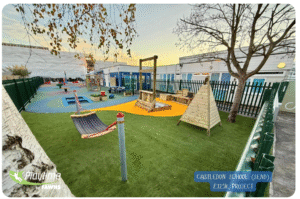
Playground equipment and surfacing should be appropriately designed, installed, inspected and maintained to standards BS EN 1176/77
These standards are not themselves the same as the School Premises Regulations. However, they are important when considering the safety and suitability of playground equipment and surfacing.
Schools should have appropriate arrangements for checking the condition of their outdoor equipment and addressing defects.
For more information, read our guide to school playground safety standards.
What should schools do if their outdoor space is no longer suitable?
If a school’s outdoor provision no longer meets the needs of its pupils, the school should review what is preventing the space from being suitable for PE and outdoor play. This could include the condition of equipment and surfacing, inclusivity, changes in pupil numbers or needs, or how the space is being used.
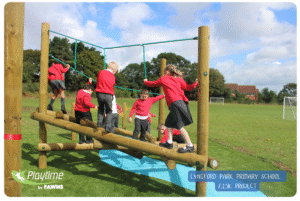
The solution will depend on the circumstances. It may involve maintenance or repairs, changes to how the space is used, or improvements to the existing provision. Schools do not necessarily need to replace an entire playground; adding new equipment can be a practical way to introduce new play opportunities, improve inclusivity or make better use of underused areas.
Read our guide to Adding New Playground Equipment: How to Upgrade an Existing Playground for advice on assessing existing equipment.
How Playtime by Fawns can help
If you’re reviewing your school’s outdoor play provision, Playtime by Fawns can help you explore what is possible within your space and budget. We have over 35 years of experience designing and manufacturing playgrounds and have installed more than 28,000 playgrounds across the UK.
Our team can help with everything from refreshing an existing playground to creating a completely new outdoor space.
Our free playground design consultation gives you the opportunity to discuss your requirements with an experienced Outdoor Play Consultant and explore how your outdoor space could be developed. Ready to make more of your outdoor space? Get in touch with us today to discuss your playground project.
What to read next..
Playground Maintenance Checklist
Outdoor Activities for Children: Why Being Active Matters
Who are Fawns?
We're the longest-established school playground equipment provider around - we know a thing or two about playground design.
With family-ran roots, schools, MATs, nurseries and parish councils trust us to create outdoor playgrounds with a purpose.


Other Blog Posts




We are the one-stop-solution for outdoor playground equipment for schools and parks across the UK.
Based in Hampshire, we pride ourselves on delivering high-quality, durable and innovative school playgrounds.
Fawns Recreational Services Limited - Company Registration Number: 03863973
Site Links
Contact
- 01252 515 199
- sales@fawns.co.uk
- Beech House, Ancells Business Park, Fleet, Hampshire, GU51 2UN

© Playtime By Fawns | 2026 website developed & maintained by digidoda
This site is protected by reCAPTCHA and the Google Privacy Policy and Terms of Service apply.