Learn More About...


Who are Fawns?
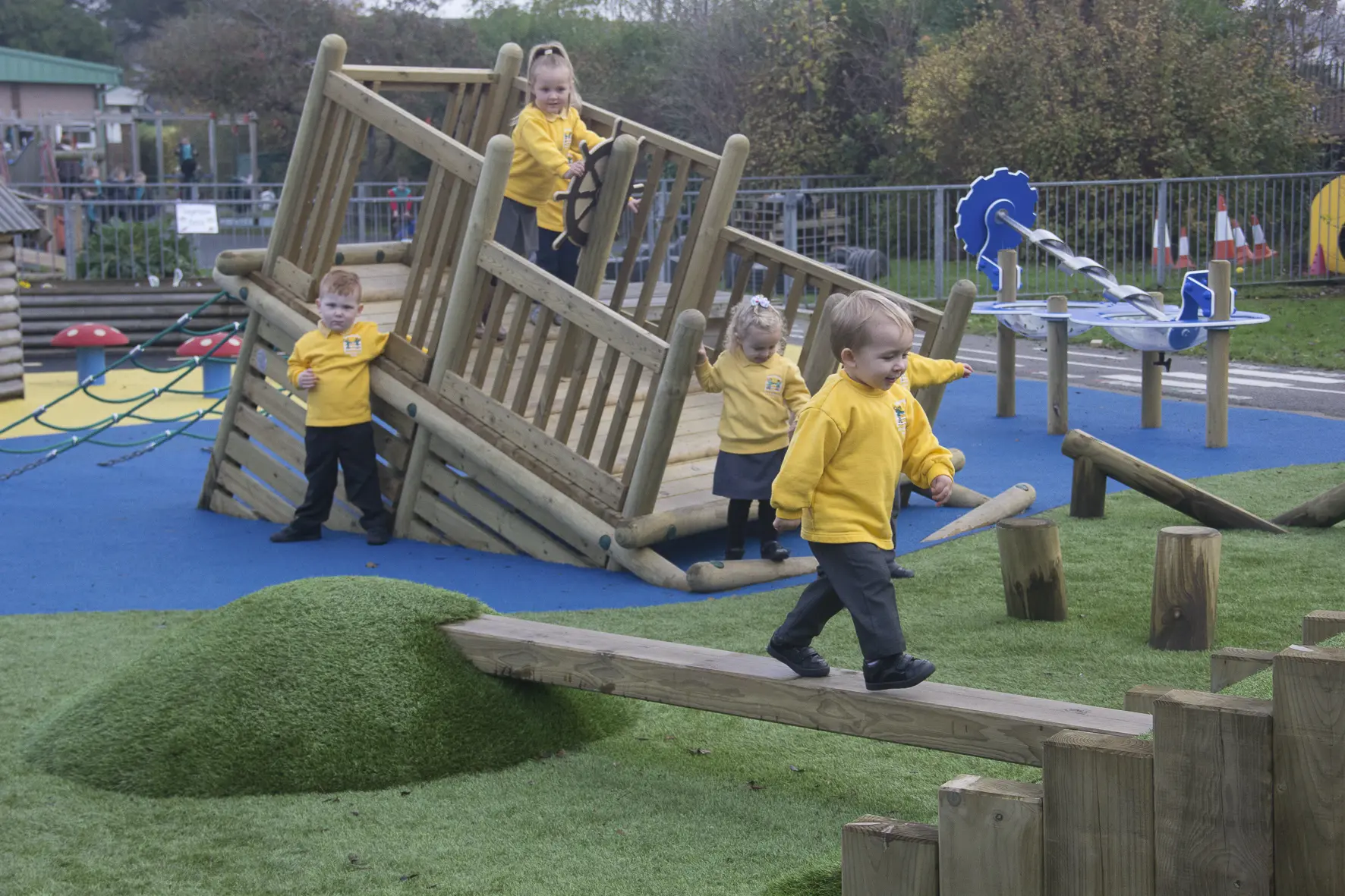
We're the longest-established school playground equipment provider around - we know a thing or two about playground design.
With family-ran roots, schools, MATs, nurseries and parish councils trust us to create outdoor playgrounds with a purpose.
EYFS outdoor area checklist: What every nursery needs
If you’re reviewing your EYFS outdoor provision this term, you’re not alone. Whether you’re setting up a brand-new school-based nursery space or refreshing what you’ve already got, it can be hard to know where to start, and harder still to know when you’ve ticked all the right boxes.
The DfE’s EYFS Statutory Framework (September 2025) is clear on the importance of outdoor play provision: all group and school-based providers must give children access to an outdoor play area.
If your outdoor space limits that possibility, then outdoor activities must be planned and taken daily.
Quality EYFS outdoor provision is a statutory requirement for all early years settings, and we’re here to help. In this blog we unpick what a well-rounded EYFS outdoor area includes, sharing an easy-to-use 8-part checklist to help you evaluate your EYFS outdoor area.
The EYFS outdoor area checklist: What do you need to have?
1. Daily access
The DfE is clear that outdoor activity should happen every day, and that means your outdoor area needs to be usable in all weathers and seasons.
Many nursery settings opt for a sheltered free flow play area to ensure outdoor play is possible, even in the changing British weather! Having access to a suitable-sized space is an essential for the early years, falling under the statutory requirements for schools when it comes to outdoor space.
2. Active and outdoor play equipment
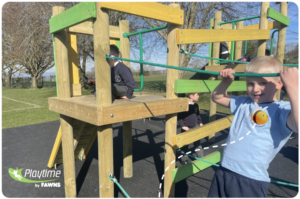
The EYFS statutory framework is very clear: ‘physical activity is vital to children’s all-round development.’
Gross and fine motor skills (coordination, core strength, balance, spatial awareness) develop through movement, and the outdoor environment is where this happens most naturally.
Your outdoor area should include equipment that gives children the chance to:
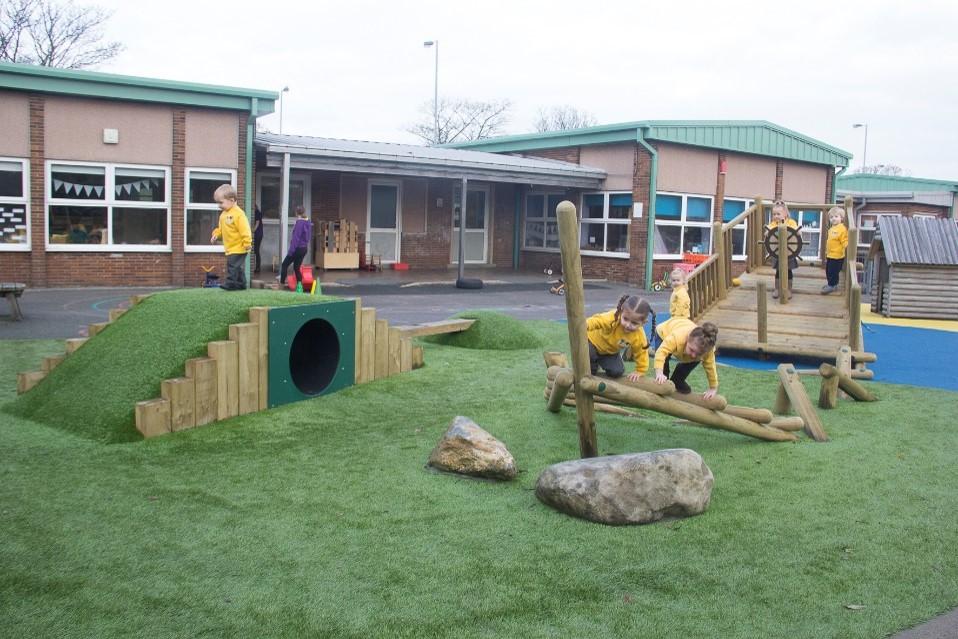
- Climb and descend safely
- Balance and test their coordination
- Jump, swing, and move their whole bodies
If you’re looking for ideas, our top 5 active outdoor play equipment picks for EYFS is a good starting point, and our guide to the best outdoor play equipment for EYFS covers how different equipment types link to the 7 areas of learning.
3. Creative and sensory play spaces
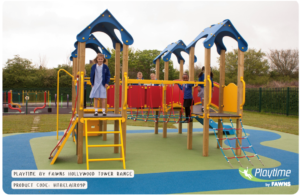
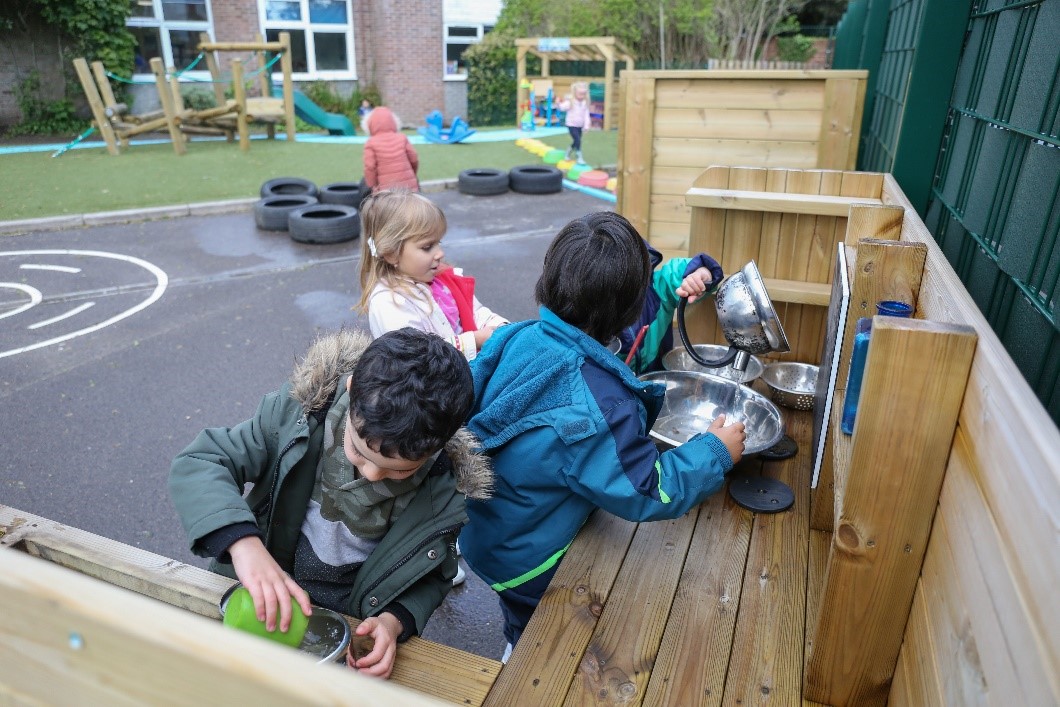
Not every child wants to push their physical development skills all of the time. A well-rounded EYFS outdoor area gives children a range of ways to explore, create, and investigate by making the most of sensory play spaces.
Exactly the type of learning the areas of Expressive Arts and Design and Understanding the World areas call for.
Think about including:
- A mud kitchen or digging area
- Sand and water play
- Loose parts (planks, crates, guttering, natural materials)
- An outdoor construction zone
4. Quiet zones and calm spaces
It’s easy to think of outdoor play as purely physical and energetic, but not all children thrive in high-energy environments, and even those who do need a place to wind down and emotionally regulate.
Quiet zones support self-regulation, emotional wellbeing, and independent play. They’re also important for children who find busy outdoor environments overwhelming.
A seating area tucked away from the hustle and bustle of the active play space, some planting to explore, or a canopied reading corner can make the outdoor space feel welcoming for every child.
As you’ll know, the link between outdoor play and mental health is well evidenced, your outdoor space should help children to connect to nature and explore their interests in a range of different ways.
5. Spaces that support communication and language
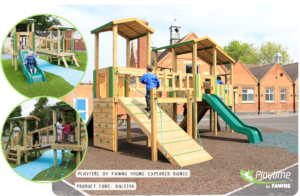
Outdoor play is one of the richest contexts for developing Communication and Language (especially for children with emerging SLCN needs).
Side-by-side play, imaginative scenarios, negotiating games, and collaborative building all generate natural conversation in a way that can be tricky to replicate indoors.
Early years practitioners can support this whilst making sure free flow play is a priority, helping children to reap the benefits of unstructured play. Choosing equipment and activities that naturally prompt communication and language development games is a great starting point.
6. Inclusive design
Every child in your setting must be able to access the outdoor area fully. The EYFS framework and the Equality Act 2010 both require non-discriminatory provision that champion inclusive play.
Which means your outdoor space needs to work for children with a range of needs and abilities, not just the most mobile and confident with physical movement.
This means thinking about:
- Level or ramped access throughout
- Sensory pathways and tactile materials
- Sensory gardens and sensory circuits available to play with
- Equipment with adapted access points
- Spaces that support children with autism to regulate
7. Safe playground surfacing
The equipment you choose matters, but so does what’s underneath it. Impact-absorbing surfacing under and around climbing and active play equipment is essential for both safety and compliance.
Equipment for EYFS settings should meet BS EN 1176 safety standards, it’s worth brushing up on what playground flooring is best for early years before making any changes to the play equipment you have currently.
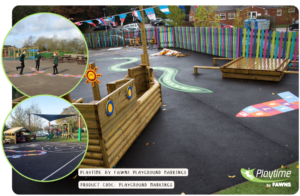
8. Defined zones
A well-zoned EYFS outdoor area reduces conflict, supports children’s ability to choose their own play, and makes observation and assessment far easier for practitioners and teachers.
When energetic and quieter activities are clearly separated, children feel safer to settle into what they’re drawn to rather than being disrupted.
Even simple zoning like using a pathway, a change in surfacing, or a low fence can transform how children use and move through an outdoor play space.
Does your EYFS outdoor area tick the boxes?
You don’t need to tackle everything at once. Even one or two purposeful additions can significantly improve what your outdoor area offers children, and how well it supports your EYFS provision.
If you’re looking for outdoor play equipment your EYFS children will love, or you’re ready to think about a bigger outdoor project, Fawns has been designing purposeful early years spaces for over 35 years.
Take a look at our recent EYFS playground projects to get some inspiration for your improvement plans.
Who are Fawns?
We're the longest-established school playground equipment provider around - we know a thing or two about playground design.
With family-ran roots, schools, MATs, nurseries and parish councils trust us to create outdoor playgrounds with a purpose.


Other Blog Posts




We are the one-stop-solution for outdoor playground equipment for schools and parks across the UK.
Based in Hampshire, we pride ourselves on delivering high-quality, durable and innovative school playgrounds.
Fawns Recreational Services Limited - Company Registration Number: 03863973
Site Links
Contact
- 01252 515 199
- sales@fawns.co.uk
- Beech House, Ancells Business Park, Fleet, Hampshire, GU51 2UN

© Playtime By Fawns | 2026 website developed & maintained by digidoda
This site is protected by reCAPTCHA and the Google Privacy Policy and Terms of Service apply.