Learn More About...


Who are Fawns?
We're the longest-established school playground equipment provider around - we know a thing or two about playground design.
With family-ran roots, schools, MATs, nurseries and parish councils trust us to create outdoor playgrounds with a purpose.
How to Choose the Right Playground Flooring for Your Outdoor Space
When you’re planning a new playground or refreshing an existing one, the equipment tends to be the exciting part. Climbing frames, trim trails, sensory zones are all firm play space favourites. But the surfacing the playground sits on is another quietly important part of your playground transformation.
Make the right playground surfacing choice and you’ll have fewer maintenance headaches, safety incidents and have a playground accessible to all children.
In this blog, we unpick all the information you need to know about playground flooring: what your options are and how to choose the best surfacing for your playground project.
Why playground surfacing matters
It’s easy to treat playground surfacing as a finishing touch, but it does a lot of heavy lifting in the day-to-day reality of your outdoor space.
Safety from falls
This is a non-negotiable. All playground surfacing in the UK must meet BS EN1177, which governs critical fall heights.
The surface must meet the safety standards and requirements for it to be thick and absorbent enough to reduce the risk of serious injury from a fall from height.
All-weather usability
Good outdoor playground flooring drains efficiently so the space stays usable year-round, not just on dry days.
A commonly forgotten decision factor with playground flooring is how slip resistant it is. Not all surfaces perform equally when wet, which is especially worth considering for shaded or exposed areas that take longer to dry.
Heat
This aspect can be something people often overlook (especially in the UK). Dark rubber surfaces can get very warm on hot days.
It’s not a dealbreaker, but shade, orientation and surface colour are something your playground providers should plan for working with sun-exposed spaces.
Accessibility
Accessibility should be built into the surfacing decision from the start, not added as an afterthought.
Smooth, firm surfaces like Wetpour work well for wheelchair users and pushchairs. Loose or uneven surfaces make access much harder, creating barriers for inclusive play opportunities.
The right surface protects the ground underneath from erosion. High-traffic areas around equipment chew through natural grass quickly, leaving mud and compaction. Carefully chosen surfaces keep the space looking and functioning well for years to come.
Playground flooring options
Here’s a rundown of the main surfaces available for schools, parks and commercial play spaces.
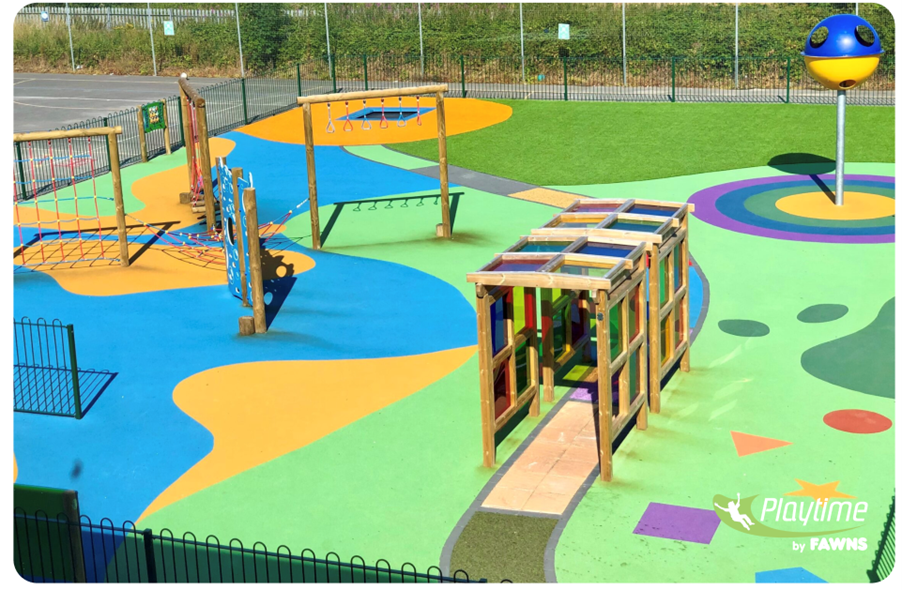
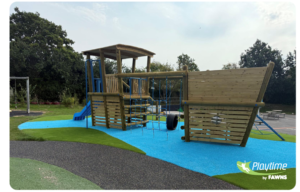
Wetpour Rubber Surfacing
This is one of the most popular choices for school playground surfacing in the UK.
Wetpour is a two-layer rubber surface with a shock-absorbing base with a coloured EPDM top (Ethylene Propylene Diene Monomer, a type of synthetic rubber).
It’s installed at thicknesses from 20mm to 140mm to meet the fall height requirements of your play equipment.
- It’s smooth, fully accessible, drains well and comes in a wide range of colours
- Games and graphics can be worked directly into the surface
- If you’ve got climbing frames or any high-level equipment, Wetpour is usually the first surface to consider
Durabond
A bonded rubber surface made from recycled shredded rubber mixed with a special binder.
It gives a more natural, earthy look than Wetpour, often using greens and browns that suit more naturalistic play zones, while still providing solid impact absorption.
Durabond surfacing can also be more of a cost-effective playground flooring option, which is always worth knowing.
- If you’ve come across the term rubber mulch elsewhere, Durabond sits in a similar space.
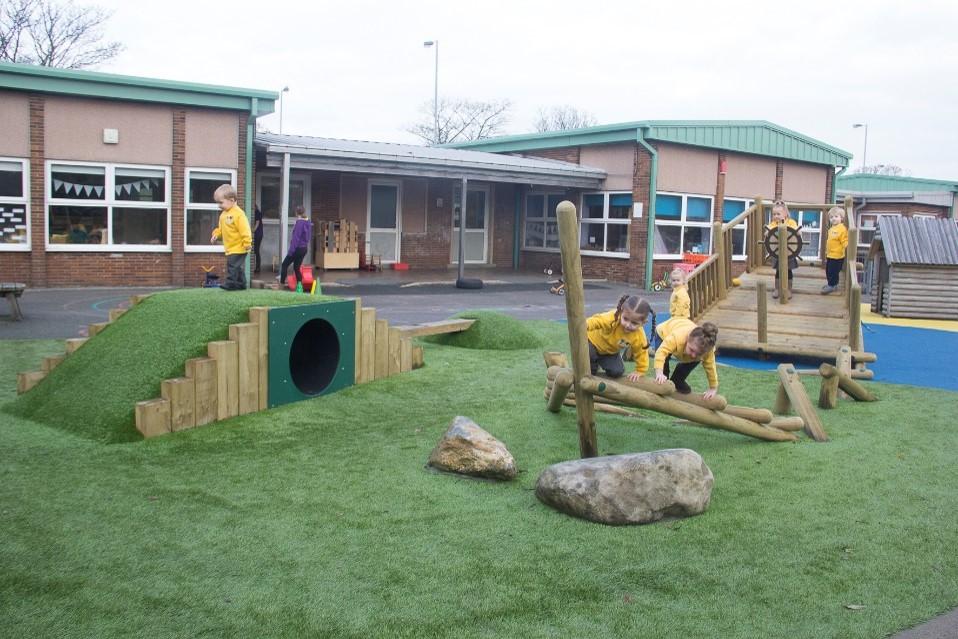
Duralawn Artificial Grass
Looks and feels like real grass but needs no maintenance and works all year round (it can also add a pop of colour to your play space).
- On its own Duralawn provides fall protection up to 1 metre (fall protection increases to 3 metres with added shockpads underneath)
- It’s popular for EYFS areas and natural play zones, and it tends to stay cooler than darker rubber surfaces on warm days
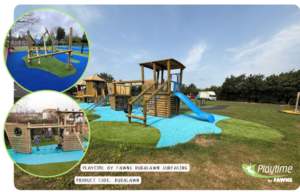
Safer Grass Tiles
These are rubber mats that sit in existing grass, letting it grow through while providing a safety layer on top.
Safer grass tiles are one of the more economical options, good for lower-level equipment and areas where you want to protect grass from heavy foot traffic without a full installation.
- Grass can still be mowed and maintained as it grows through the grass tiles
- Safer grass tiles are suitable for equipment up to a 2.1m Free Fall Height
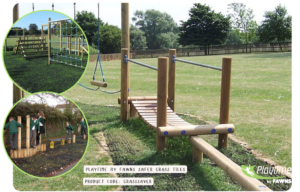
Loose Fill Bark
A traditional option for play area flooring and still earns its place in natural play areas and woodland zones.
A favourite with some commercial play areas like caravan sites, Loose fill bark is natural looking and reasonably priced.
It can sometimes create some barriers for wheelchair users and pushchairs, so think carefully about where you use it and the benefits for your play space
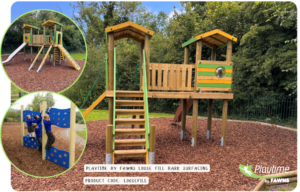
Sensory Paths
Less about fall protection and more about experience. Sensory paths combine textures like pebbles, wood, resin bonded gravel and smooth stone into a walkway that encourages exploration and sensory engagement.
They’re a great fit for SEND provision and EYFS outdoor learning and community spaces that prioritise sensory play opportunities.
They can also work well as a connecting feature between different play zones
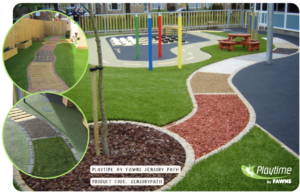
Playground Markings
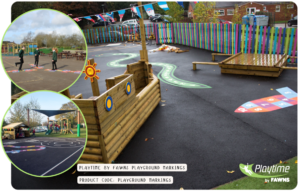
Playground markings aren’t a surface in themselves but they’re worth including because they change how a space gets used.
We commonly see playground markings like number grids, phonics trails, fitness circuits as choices for school and community play spaces.
Thermoplastic line markings can be laid onto a hard standing surface, they can turn a passive space into an active learning space at relatively low cost.
How to choose the right playground surface
Start with the equipment
The height of the play equipment you’re installing determines the critical fall height requirement, which will decide suitable surfaces and how deep they need to be.
A low-level trim trail and a 4-metre high-ropes playground have very different needs.
Think about who’s using it
- EYFS children need soft, forgiving surfaces
- Children with SEND or mobility needs require smooth, firm and even surfaces, accessibility should drive that decision
- Older KS2 children on higher equipment need surfaces that prioritise safety from higher-risk equipment accordingly
Look at upfront versus long-term cost
Bark is cheaper to install but needs regular topping up. Whereas Wetpour can cost more initially but is lower maintenance for years.
We recommend you calculate the maintenance needs (or have your playground provider help you) over a five-to-ten-year period before deciding.
Think about your worst weather days, not your best
Drainage, slip performance and how a surface handles heat, rain or shade should all be part of the conversation with your playground supplier as standard.
Can you mix playground surfaces?
Yes, and many playgrounds do. Some of the best outdoor spaces use different surfaces in different zones.
Wetpour under the climbing frame, Duralawn in the open play zone, bark in the natural area, a sensory path running between them.
It also helps with visual zoning, making it clear to children how different parts of the space can be used.
How Fawns work with schools
With over 35 years of experience working with schools, local authorities and community play spaces across the UK, our expert team at Playtime by Fawns understands that no two playgrounds are the same.
Every project starts with a conversation about your space, your users and your budget, and runs through to full installation by an experienced team working to BS EN1177, RoSPA and API guidelines.
Get in touch today to arrange a free playground consultation visit or check out our recent playground projects for inspiration.
More articles you’ll like:
Our guide to maximising outdoor spaces
12 PTA fundraising ideas for playground equipment: A guide for UK schools
Who are Fawns?
We're the longest-established school playground equipment provider around - we know a thing or two about playground design.
With family-ran roots, schools, MATs, nurseries and parish councils trust us to create outdoor playgrounds with a purpose.


Other Blog Posts




We are the one-stop-solution for outdoor playground equipment for schools and parks across the UK.
Based in Hampshire, we pride ourselves on delivering high-quality, durable and innovative school playgrounds.
Fawns Recreational Services Limited - Company Registration Number: 03863973
Site Links
Contact
- 01252 515 199
- sales@fawns.co.uk
- Beech House, Ancells Business Park, Fleet, Hampshire, GU51 2UN

© Playtime By Fawns | 2026 website developed & maintained by digidoda
This site is protected by reCAPTCHA and the Google Privacy Policy and Terms of Service apply.