
Learn More About...


Who are Fawns?
We're the longest-established school playground equipment provider around - we know a thing or two about playground design.
With family-ran roots, schools, MATs, nurseries and parish councils trust us to create outdoor playgrounds with a purpose.
6 Non-Competitive Activities to Try: Engaging Less Active Children
Are you looking for more non- competitive activities for the children in your class? For some children, traditional competitive sports like football, netball, or athletics can feel intimidating, especially if they don’t see themselves as “sporty.” These children, often the least active, risk missing out on the wide-ranging benefits of physical education, including confidence-building, social connection, and improved mental health.
In this article, you’ll find clarity on what makes a sport non-competitive and 6 fund activities and games to try with your class.
Non-competitive, whole-class activities can change this. They promote fun, creativity, and teamwork without the pressure of scoring goals or being the fastest. They give every child a way to move, explore, and enjoy being active, regardless of skill level.

What Makes Sport Non-Competitive?
When it comes to children and outdoor sporting activities, there’s a constant conversation about the best way to develop them. It often boils down to whether a competitive spirit or a more non-competitive focus is more beneficial for their athletic growth, social skills, and overall well-being.
So, how can you make PE lessons non-competitive, ensuring that every child feels valued and motivated to participate, regardless of their athletic ability?
Here are 5 ways a sport can be non-competitive, where the children participate purely for the love of movement!
- Praise effort, not outcome
Celebrate every attempt and improvement, no matter how small. Identifying determination and persistence builds confidence. Encouraging children to keep trying without the fear of failing or “not being good enough.” - Avoid eliminations
Design activities where no one sits out. Instead of traditional games with winners and losers, use inclusive formats where all children stay active throughout, such as rotating roles or cooperative challenges. - Add themes, music, or storytelling for emotional and creative hooks
Turn physical activity into an adventure! Use music for rhythm and energy, or frame exercises as parts of a story (e.g. jungle trek, space mission) to ignite imagination and give children a reason to move beyond just “exercise.” - Let children lead parts of the activity where possible
Offer opportunities for children to suggest moves, lead a warm-up, or invent a game rule. This promotes ownership, builds leadership skills, and often helps reluctant participants feel more valued and engaged. - Make fun and movement the goals, not performance
Shift the focus from “how well”. Prioritise enjoyment and active participation over competition or technique. When children associate physical activity with fun, they are more likely to stay active in the long term.
6 Non – Competitive Sporty Activities
The engaging activities detailed throughout this blog aren’t just fun; they’re designed to directly align with and support the core objectives of the National Curriculum for PE for both Key Stage 1 and Key Stage 2. Meaning as teachers and PE leads you can confidently integrate them into your PE lessons, contributing to children’s physical development and learning goals.
Let’s explore a range of whole-class, non-competitive activities that are worth trying out in your next PE lesson.
1. Obstacle Course Adventure
Curriculum Link:
- KS1: “Develop fundamental movement skills…”
- KS2: “Use running, jumping, throwing and catching in isolation and in combination.”

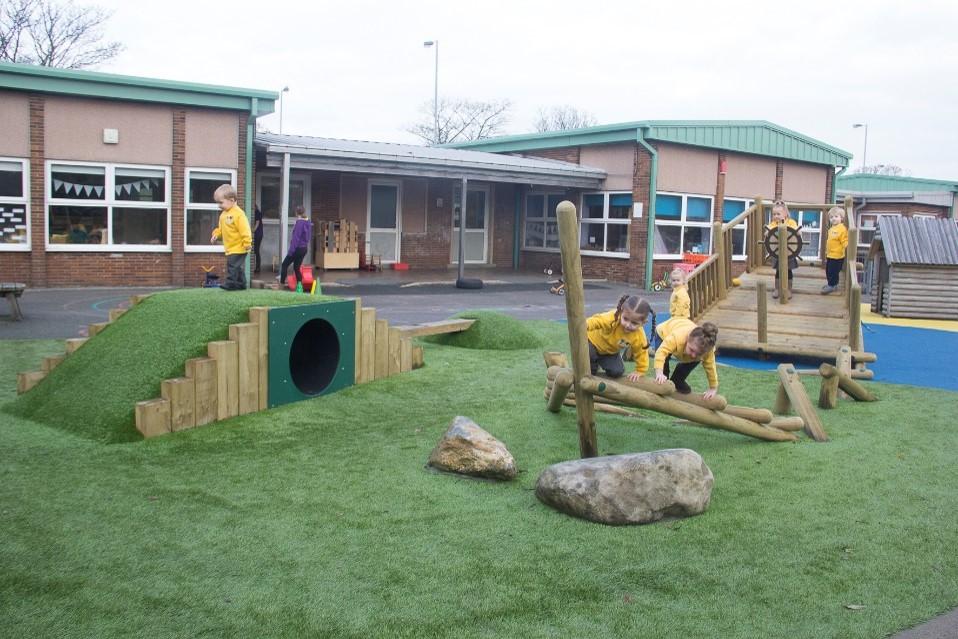
Lesson Idea: Create stations with balance beams, cones to zigzag through, tunnels to crawl under, and ladders to step through. Children work individually or in pairs, focusing on balance, coordination, and agility.
The Moveable Timber Trail Range is ideal for this activity, as it can be easily rearranged and adapted to suit the needs of any obstacle course adventure.
Learning Concept: Children will learn to judge distances, change speed and direction effectively. Maintaining control over their movements while adapting to different physical tasks.
2. Parachute Games
Curriculum Link:
- KS1: “Participate in team games, developing simple tactics for attacking and defending.”
- KS2: “Take part in outdoor adventurous activity challenges both individually and within a team.”
Lesson Idea: Use games like Cat and Mouse, Waves, and Mushroom to develop teamwork and
coordination. Use the parachute to build listening skills and collaborative timing.
Learning Concept: Children will learn how to work as part of a team, follow group cues, and respond to changing dynamics, all of which support social and emotional development alongside physical coordination.
3. Nature Scavenger Hunt
Curriculum Link:
- KS1: “Master basic movements such as running and walking…”
- KS2: “Take part in outdoor and adventurous activity challenges…”
Lesson Idea: Create a scavenger list of natural items. Include movement tasks like “hop to a tree,” “skip to a log,” or “crawl under a bush.” Promoting exploration and body awareness in nature.
Learning Concept: Children develop body awareness, directional movement, and confidence navigating uneven outdoor spaces while engaging curiosity and learning to move purposefully in response to natural cues.
4. Outdoor Yoga
Curriculum Link:
- KS1 & KS2: “Develop balance, agility and coordination…”

- Supports emotional wellbeing and self-regulation.
Lesson Idea: Guide students through a series of themed poses (e.g., jungle animals or space). End with a calm breathing activity. Focus on balance, flexibility, and mental focus.
Learning Concept: Children learn to focus their attention, control their breathing, and develop postural stability, all while improving physical coordination and managing stress in a fun, imaginative manner.
5. Team Games
Curriculum Link:
- KS1 & KS2: “Engage in competitive and co-operative physical activities in a range of increasingly challenging situations.”
Lesson Idea: Games like Pass the Hoop (through linked arms) or Balance the Ball (teams balance a ball using only string or flat paddles). Develop communication, strategy, and collaboration.
Learning Concept: Children learn to communicate clearly, listen to others, and adapt strategies as a group. These activities reinforce the value of every team member and highlight success through cooperation rather than competition.
6. Giant Chalk Playground
Curriculum Link:
- KS1: “Develop balance, agility and coordination…”
- KS2: “Use running, jumping, throwing and catching in isolation and in combination.”
Lesson Idea: Students draw their own movement paths (e.g., zigzags, hopscotch, spin points). Rotate through each other’s courses. Focus on sequencing and motor planning.
Learning Concept: Children engage in decision-making as they create and follow movement patterns, developing coordination, rhythm, and the ability to anticipate and adjust their movements in a playful, expressive environment.
Physical education isn’t just about athletic ability, it’s about giving every child a joyful, safe space to explore movement. Non-competitive activities help shift the spotlight from winning to participating, from pressure to play.
Let’s ensure that every child, especially the least active, finds something they love about moving. These activities, grounded in the national curriculum but elevated with creativity and care, are a step toward lifelong physical confidence.

How Can Fawns Help?
If you’re interested in exploring playground projects, whether for competitive sports, non-competitive activities, or a mixture of both, our team is here to help.
We’re committed to creating play environments that support physical development, inclusivity, and the goals of your school or community.
Feel free to Contact Us today!
More Articles We Think You’ll Like
What Does Ofsted Say about Fundamental Movement Skills?
Who are Fawns?
We're the longest-established school playground equipment provider around - we know a thing or two about playground design.
With family-ran roots, schools, MATs, nurseries and parish councils trust us to create outdoor playgrounds with a purpose.


Other Blog Posts




We are the one-stop-solution for outdoor playground equipment for schools and parks across the UK.
Based in Hampshire, we pride ourselves on delivering high-quality, durable and innovative school playgrounds.
Fawns Recreational Services Limited - Company Registration Number: 03863973
Site Links
Contact
- 01252 515 199
- sales@fawns.co.uk
- Beech House, Ancells Business Park, Fleet, Hampshire, GU51 2UN

© Playtime By Fawns | 2026 website developed & maintained by digidoda
This site is protected by reCAPTCHA and the Google Privacy Policy and Terms of Service apply.