Learn More About...


Who are Fawns?
We're the longest-established school playground equipment provider around - we know a thing or two about playground design.
With family-ran roots, schools, MATs, nurseries and parish councils trust us to create outdoor playgrounds with a purpose.
What children learn from unstructured outdoor play in EYFS
When children are given opportunities to play with no ceiling and planned outcome, they begin to figure things out for themselves. And develop by default.
There’s a unique pressure on learning and development in early years. It’s a statutory requirement for children to learn through play, yet there’s a large list of vital foundational skills and knowledge for children to be ready for their next stage of education.
Unstructured play in early years plants seeds of curiosity. Allowing children to strengthen a whole host of skills like imagination, communication and language and even sequencing of stories and games.
In this blog, we unpick just what early years children learn through unstructured outdoor play
What’s the difference between structured and unstructured outdoor play?
Structured play is adult-directed or adult-initiated. There’s an intended outcome: a skill being practised, a concept introduced, a learning area being targeted. It’s purposeful in a way that’s easier to observe, plan for, and show evidence of impact.
Whereas unstructured play is child-led, open-ended, and driven entirely by curiosity and choice with no predetermined outputs. Children decide what to do, who with, and how, supported by an EYFS outdoor area that’s designed to develop.
The myth behind unstructured play in early years
The important thing to understand is that unstructured doesn’t mean unproductive. It means the learning is led by the child rather than the practitioner or teacher. And in many cases, that shift in ownership is exactly what makes the learning stick.
Building foundational skills, but by choice
The EYFS framework is built on the understanding that children learn through play.
But there’s a meaningful difference between first learning a skill and then developing and applying it (by choice).
Think of it like this: a practitioner might introduce the concept of capacity through a guided water activity. But it’s in the unstructured water play afterwards, filling, emptying, comparing, experimenting, that the concept takes root.
The child isn’t ticking off a learning objective; they’re just absorbed in something that interests them. And that absorption is exactly the condition in which deep learning happens.
This is why unstructured outdoor play is one of the most powerful ways to consolidate foundational learning.
What are children learning? Let’s look at each area
Personal, Social and Emotional Development
PSED is arguably the area that benefits most from unstructured play, because it simply can’t be taught, it has to be lived.
- Who decides the rules of the game?
- What happens when someone doesn’t follow them?
- How do you join a group that’s already playing?
These are complex social situations, and children navigate them constantly during free play without an adult mediating every moment.
Turn-taking, empathy, frustration tolerance, self-regulation skills are all practised in real conditions during unstructured outdoor play. It’s the opportunity for application young children need to develop socially and build friendships.
Communication and Language
Outdoor free play generates more natural, varied conversation than almost any other context in the early years day. Collaborative play, imaginative scenarios, negotiating games, and by directing each other around a space, children are using and stretching their language constantly, and they’re doing it because they want to, not because they’ve been asked to.
For children with emerging Speech, Language and Communication needs (SLCN), the low-pressure nature of child-led outdoor play can be particularly valuable.
It’s why early years teachers favour communication and language games that feel unstructured to children but are quietly supporting language development throughout.
Physical Development
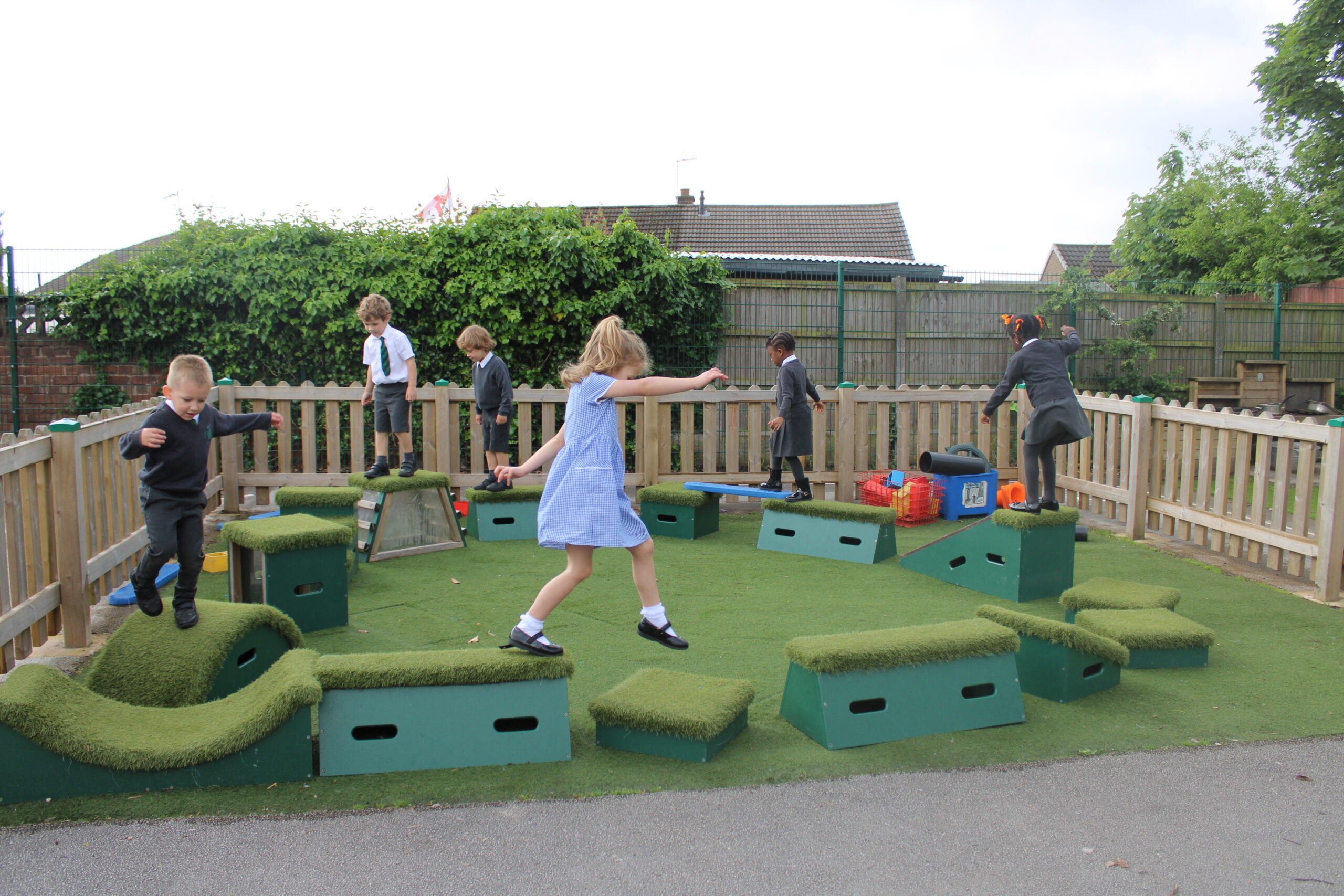
The EYFS framework explains that physical activity is vital to children’s all-round development, and unstructured outdoor play is where physical development happens most organically.
When children are free to move in ways they choose, they naturally push their own limits.
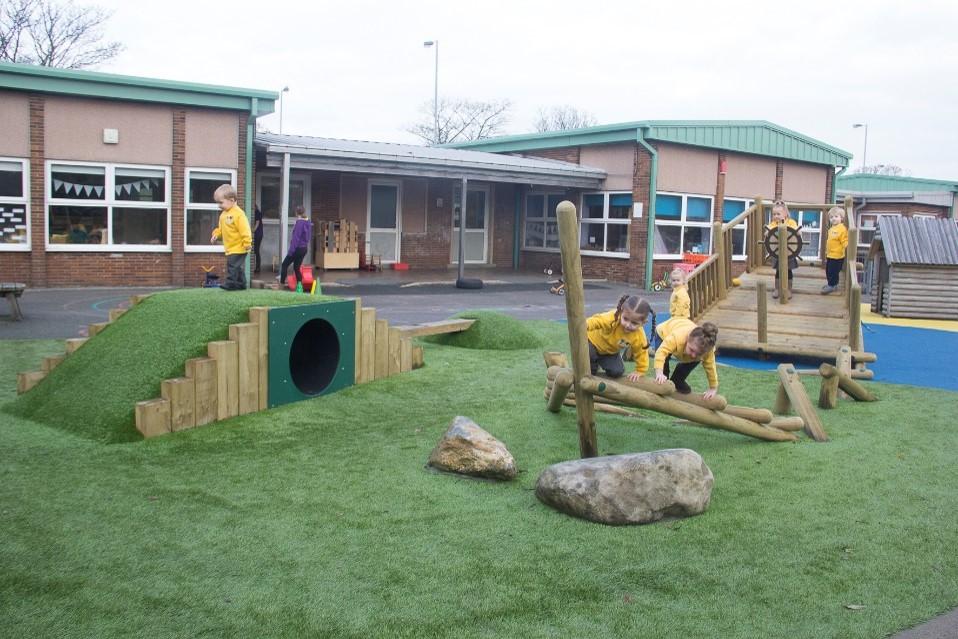
They climb a little higher than last week. They try a different route across the equipment. They challenge each other to run faster, balance longer, jump further.
This self-directed physical challenge builds confidence and body awareness in a way that structured PE can sometimes struggle to replicate. It’s why Ofsted are so keen to see how the Fundamental Movement Skills are prioritised in schools.
It’s also worth thinking about whether your outdoor space gives all children equal opportunity to be physically active. Specifically looking at your most vulnerable pupils and those less likely to participate in sport consistently, like girls.
Literacy
Unstructured outdoor play is rich territory for early literacy development, particularly in the areas of storytelling, narrative, and early mark making.
Children in free play create stories constantly. They build worlds, assign roles, establish plots, introduce problems, and resolve them. This is the imaginative and language infrastructure that reading and writing sit on top of.
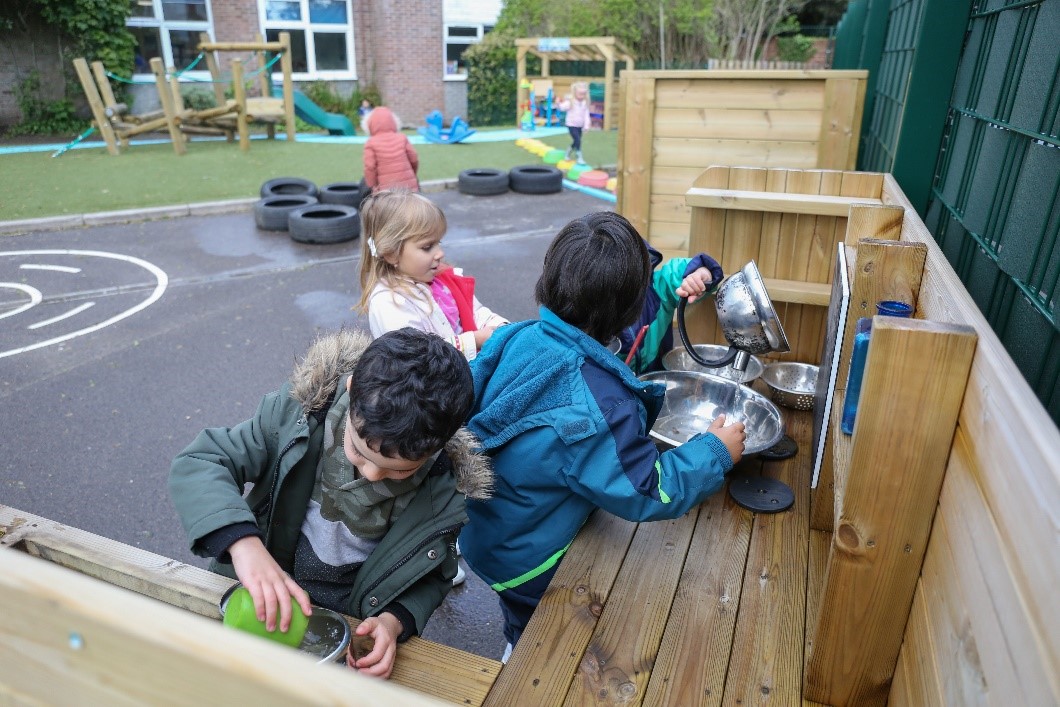
An EYFS outdoor construction area, a loose parts collection, or a simple mud kitchen can be the setting for remarkably sophisticated narratives.
Mathematics
Outdoor free play is full of mathematical thinking, filling containers, building structures, sorting natural materials, working out whether something will fit, figuring out how many of one thing equals one of another.
These are all examples of how quantity, shape, space, and measure are explored in a completely natural, self-motivated way. The outdoor environment offers a richness of mathematical experience that’s very hard to manufacture at a table.
Understanding the World
Outdoors is where Understanding the World comes alive through:
- Weather
- Seasons
- Living things
- Cause and effect
- The properties of materials
Children in unstructured outdoor play encounter all of this on their own terms, driven by their own curiosity.
A child who spends twenty minutes investigating what happens when you add water to different types of soil is doing science. And this self-directed investigation is exactly the kind of deep, absorbed engagement that builds lasting understanding rather than surface-level familiarity.
Expressive Arts and Design
When there’s no end-product to produce and no adult directing the outcome, children use materials, spaces, and objects in endlessly inventive ways.
Open-ended outdoor resources like loose parts, natural materials, sand, water, crates, fabric give children a blank canvas to play creatively.
The creativity is the kind of original, flexible thinking that underpins Expressive Arts and Design across the EYFS, and it’s a skill that only grows stronger the more it’s exercised.
How Fawns works with EYFS settings
Playtime by Fawns has been working with nurseries and early years settings for over 35 years.
We understand that no two settings are the same. Some are working with generous outdoor space and need help making the most of it, others are squeezed into a small courtyard and need to think creatively about how to get the most from the space.
Every project starts with a free design visit. One of our playground consultants will come to your setting, get a feel for the space and the children who use it, and talk through what you’re hoping to achieve. From there, our in-house design team produces a visual 3D concept, something to show to parents, governors, or your PTA when you’re making the case for investment.
Our wooden play equipment is designed and manufactured in the UK, installed by our own Fawns team, and built to last.
If your outdoor space isn’t quite doing what you need it to do for your children, take a look at some of our recent EYFS projects to see what’s possible, or get in touch to arrange your free design visit.
Who are Fawns?
We're the longest-established school playground equipment provider around - we know a thing or two about playground design.
With family-ran roots, schools, MATs, nurseries and parish councils trust us to create outdoor playgrounds with a purpose.


Other Blog Posts




We are the one-stop-solution for outdoor playground equipment for schools and parks across the UK.
Based in Hampshire, we pride ourselves on delivering high-quality, durable and innovative school playgrounds.
Fawns Recreational Services Limited - Company Registration Number: 03863973
Site Links
Contact
- 01252 515 199
- sales@fawns.co.uk
- Beech House, Ancells Business Park, Fleet, Hampshire, GU51 2UN

© Playtime By Fawns | 2026 website developed & maintained by digidoda
This site is protected by reCAPTCHA and the Google Privacy Policy and Terms of Service apply.